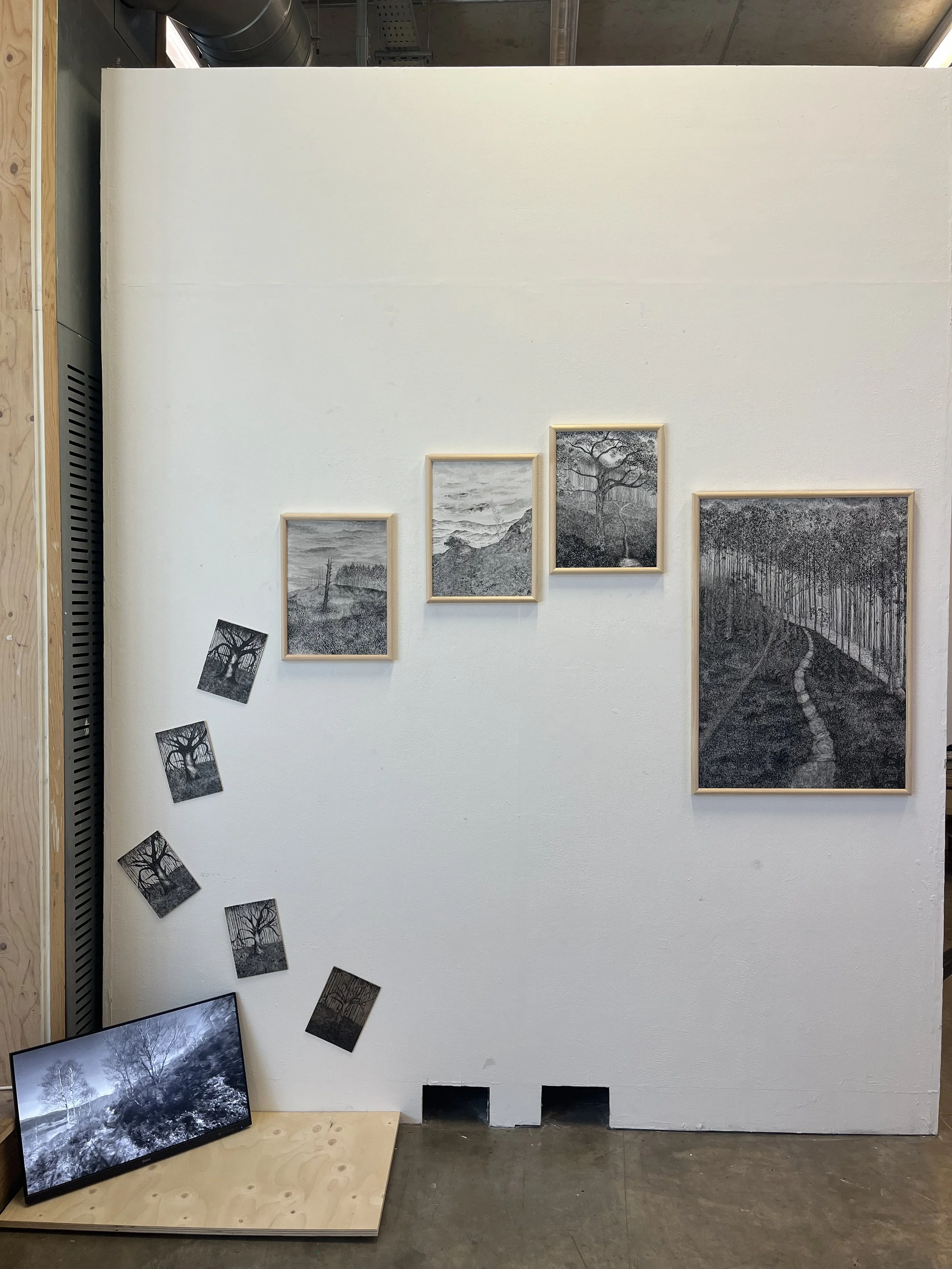
Understory.
Understory is the collective title for the five works shown together at my Central Saint Martins MA Fine Art: Digital graduate show, and a theme that has run through my practice for the past two years.
The work is arranged in a spiral, beginning in the bottom left corner with a screen showing an extended video of walks I have taken around Kingussie. The footage closes on the paintings Gynack and Creag Bheag in the landscapes that inspired them. Returning to a place, again and again, to paint it, photograph it, and walk it, is a recurring part of how I work, and it felt right for the spiral to begin here, with that act of return.
From the video, the eye is drawn along five A5 plywood sheets. Each one carries the same image, hand painted in calligraphy ink onto a board prepared with a different number of coats of white emulsion, the first sheet left unprimed entirely. The image shifts slightly each time, distorted by the surface beneath it and by the repetition of painting the same thing over and over. I think of this as a way of exploring masking, and the layers, or labels, placed on us by others and by ourselves, and how something can look different depending on what lies underneath.
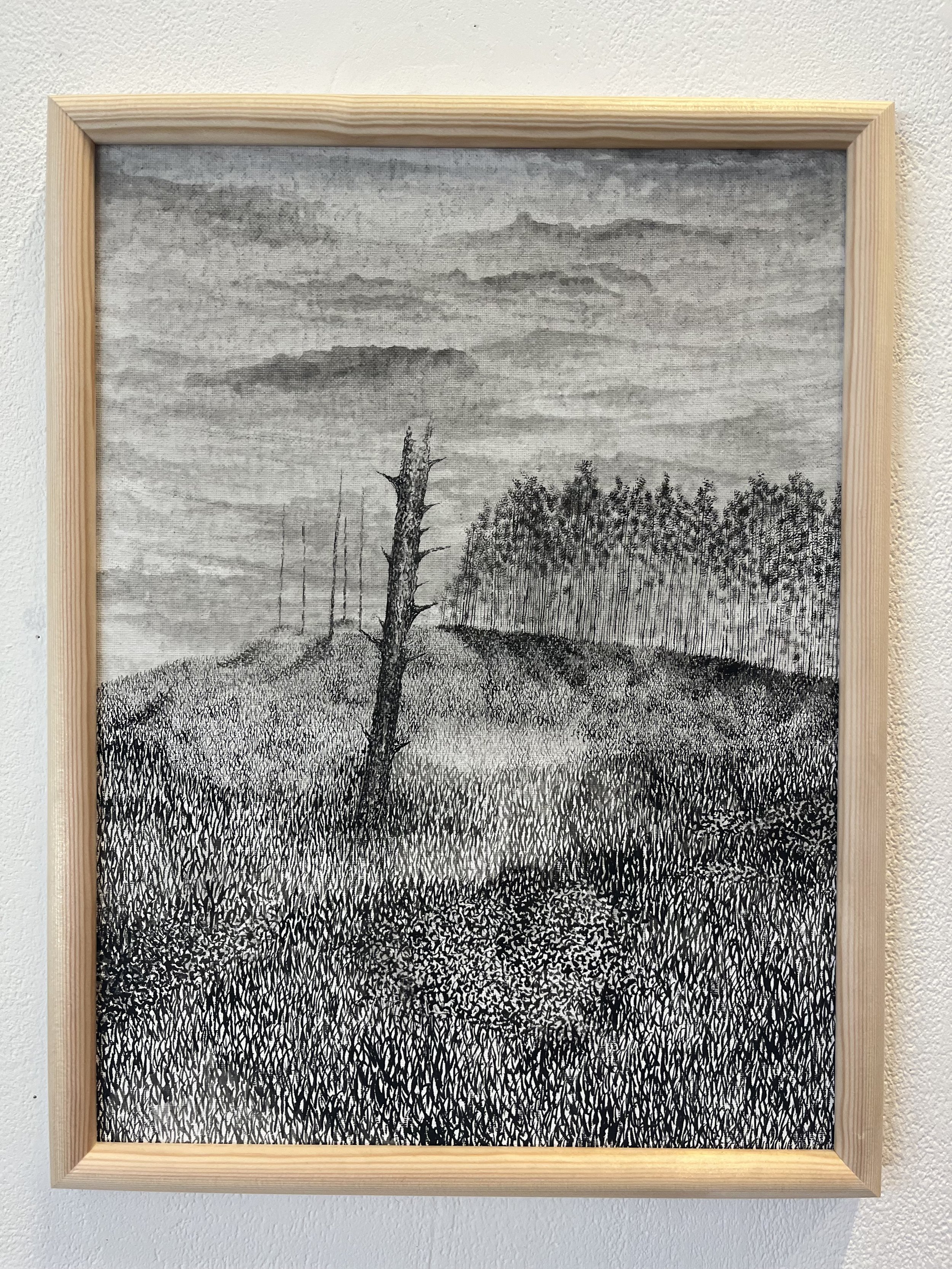
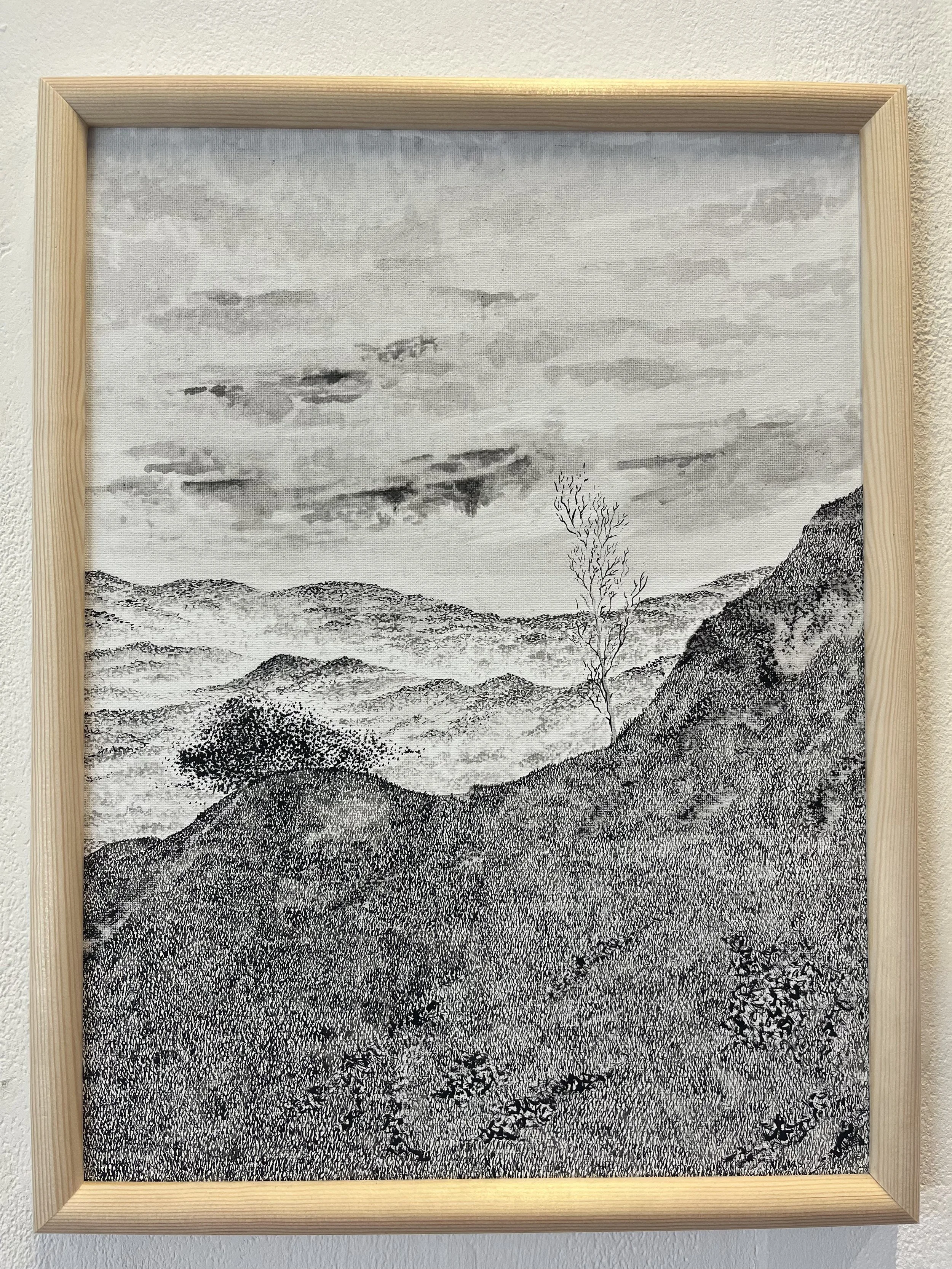
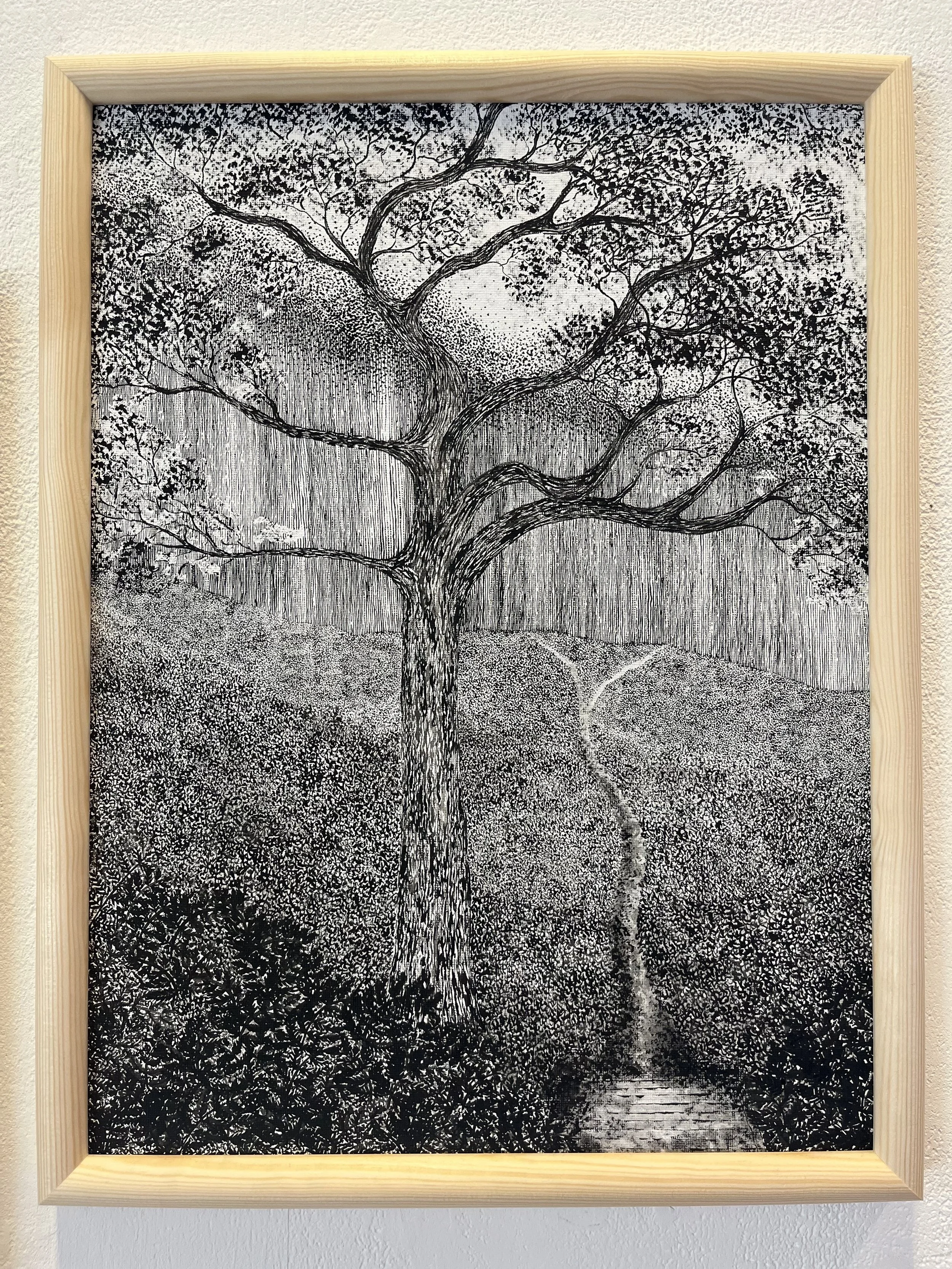
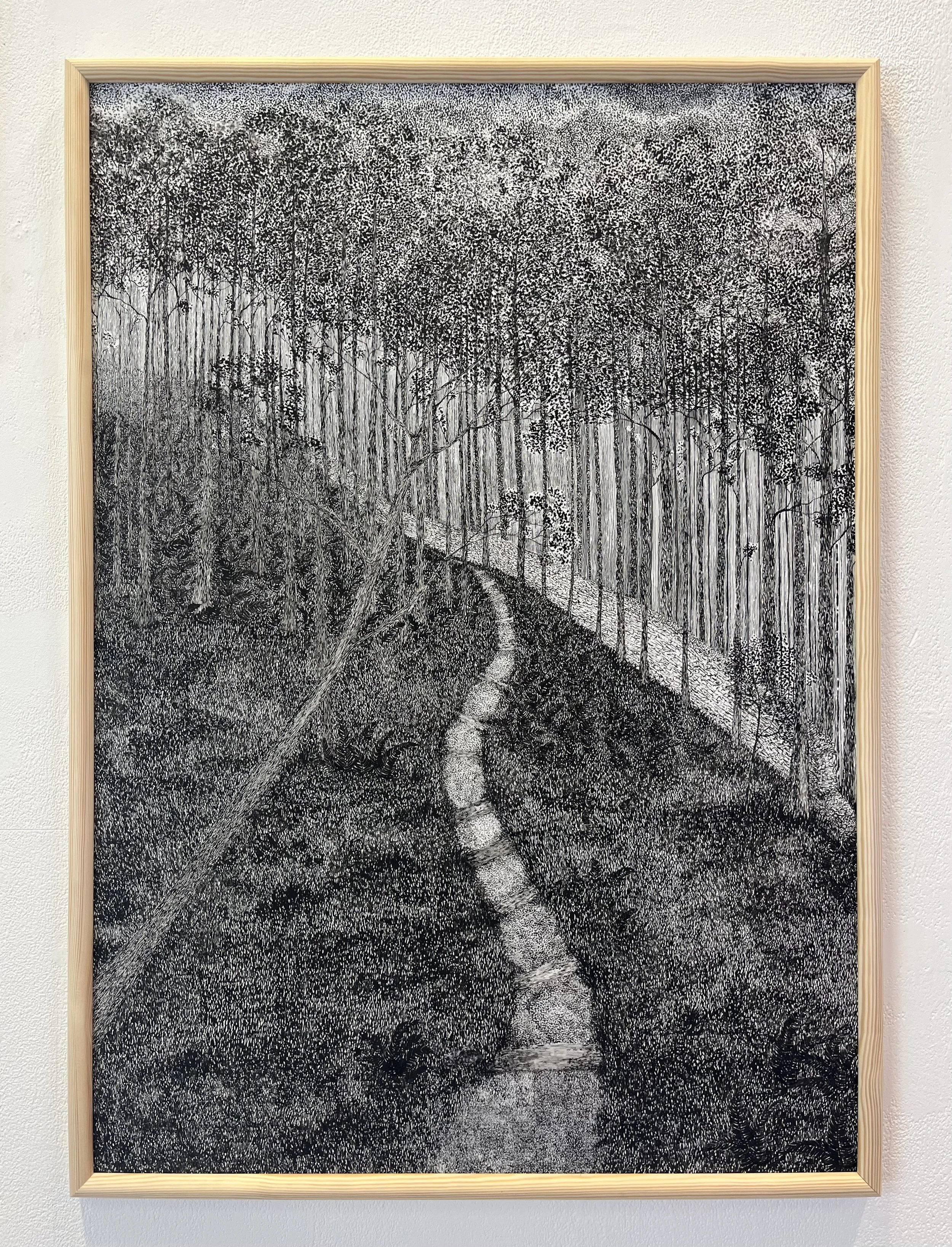
The spiral then arrives at four paintings, each hand painted in calligraphy ink on canvas board and framed in raw pine. Every mark is built up by hand, brushstroke by brushstroke, rather than printed or carved, and each piece takes many hours to complete.
It begins with Snags of Drumguish, a contemplative painting of the skeletal forms of dead trees standing in the raw, untamed landscape near Drumguish. These remnants, often overlooked, hold a haunting beauty, their exposed forms carrying themes of time, loss, endurance, and renewal. Built up slowly through layered washes of black calligraphy ink, the piece is deliberately desolate, the starting point of the spiral's journey.
Next comes Creag Bheag, inspired by a walk to the summit of the hill that looks out over Kingussie. Near the exposed peak, a solitary silver birch grows in a place it has no business growing, wind-battered and unlikely, and yet it endures. That tree connects to a thread that has become central to my practice and was the focus of my research earlier in the course: the relationship between the particular shapes trees make as they adapt to their environment, and the experience of living with chronic pain, of a body that has had to find its own way of moving through the world. Adapting to your environment is not a compromise but a form of strength, and growing differently is not growing wrongly.
From there, the spiral moves to Gynack, a deeply personal painting rooted in the landscape of Kingussie. This was the first piece I completed following my autism and ADHD diagnosis, and that shift is present in how it was made, a feverish, uninterrupted accumulation of marks, trusting the momentum of the making rather than stopping to question it. It is less a landscape painting than an attempt to externalise something that resists direct expression, to let the body process through the marks what the mind struggles to name. Where Creag Bheag holds a single enduring tree at an exposed summit, Gynack shows a tree thriving at the edge of a forest, a shift from survival towards belonging.
The spiral closes with Dùthchas, the largest painting in the series and the piece the title of the show is named for. Where Gynack stands at the forest's edge, Dùthchas brings the viewer inside it, a path stretching out ahead. Dùthchas is a Gaelic word that speaks to a sense of belonging to a place, an inherited connection that runs deeper than ownership. Alongside Gynack, this piece sits within my continued exploration of alexithymia, and the broader thread in my work of painting as an alternative language, a way of saying something that resists being put into words.
If you would like to see the works in person, the show runs from 1st to 5th July at Central Saint Martins, King's Cross. Original paintings from this series will also be available to purchase in my shop.