“Gynack”.
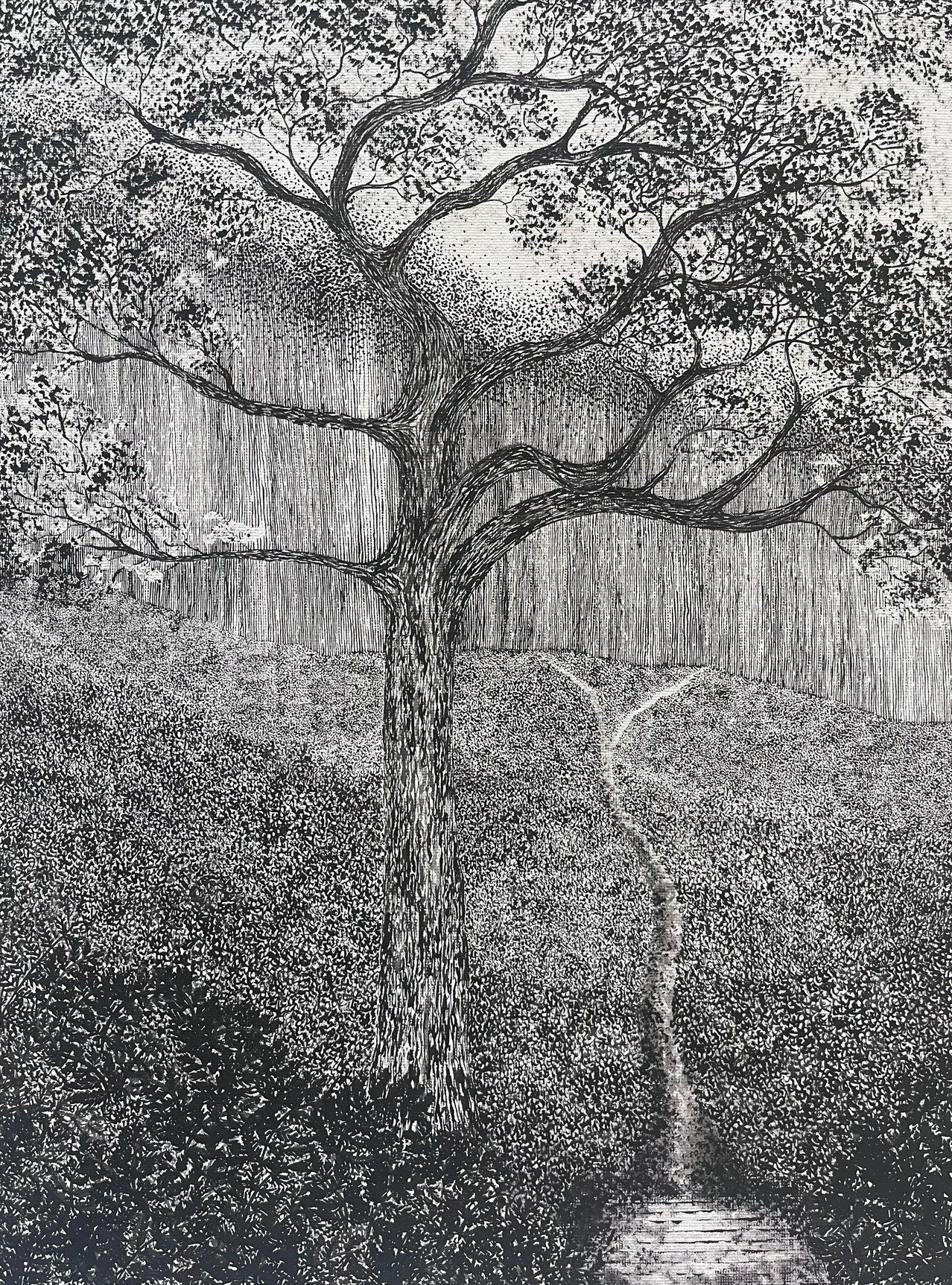
Gynack | 30×40cm | ink on Canvas Board
On the 27th of March I completed a painting titled "Gynack", named after the place that inspired it during my trip to Kingussie in the summer of 2025. This is the first painting I worked on and completed since being diagnosed with autism and ADHD, and it marks the beginning of exploring the relationship between those diagnoses, my alexithymia, my art practice, and how neurodivergence can influence creative practice more broadly.
Reflecting on the process of this painting, there was something freeing in how it unfolded. I was able to lean into a feverish need to fill the canvas and trust my instincts, without feeling the pressure to stop and actively question what I was doing or why. The process felt a lot quicker than it has in the past. Previously there have been long pauses and a lot of thinking in between marks: is there enough balance, does it need more blank spaces, why this colour, why that gesture. With Gynack, I tried to resist that pull and just keep going, only allowing myself to stop and stand back towards the very end, once the canvas was almost completely full.
For this painting I have also tried to embrace the abstract textures I have been exploring in my sketchbook. This abstract mark making practice feels key to these pieces and has a strong link to the themes I am starting to explore. With alexithymia there is a distance from recognising your own emotions, and the marks work in a similar way: looked at in isolation they are just abstract marks without much meaning, but when you stand back and take them in as a whole that is when they start to come together. Something in the physical act of making these marks feeds into what my brain craves, something that requires constant repetitive movement, that I can also focus on completely and be drawn into, freeing myself within the process and away from the pressures and expectations of the outside world. In that state there is no self-editing, just the work unfolding.
It feels like something is starting to break through into new territory. There is a different energy in this painting, something I am also noticing in my sketchbook practice. The canvas is becoming an extension of the body, a way to allow the body to process externally and have an exchange with the work. It reminds me of the way a landscape communicates with its trees through root systems, sending signals of drought or disease across the wider terrain. The painting becomes its own kind of communication network, something felt before it is understood.
This painting feels like the start of a new series exploring the overlap of neurodivergence, alexithymia, chronic pain and embodied experience, and what those things mean for an art practice. Tied to that is the importance of place, and the landscape as a translation for embodied experience, which brings me back to the photographs from my trip to Kingussie last summer and why they have stayed with me. The Scottish Highlands were the backdrop to a key period in my life when I was growing up. We lived there for six years, and while that might sound brief, those years carry a disproportionate weight in my memory. They are the ones that stand out most when I look back at my childhood, shaped by the particular quality of that landscape, its scale, its light, its sense of deep time. The Highlands are also the stage for a great deal of the history and stories that have been passed down through my family, threads of belonging and identity that stretch back long before my own time there. There is something in returning to that landscape, even through memory and image, that feels less like looking outward and more like a form of recognition.
Chronic pain is another thread running through this work, even when I am not consciously aware of it. Living with scoliosis, hypermobility and fibromyalgia means that chronic pain is always present, always there in the background, and it is hard to imagine how it could not find its way into the work when you think of it in those terms. As I have explored in previous pieces, it shows up in the landscape and particularly in the trees, in the way that something growing differently is not growing wrongly. That connection between my scoliosis and the particular shapes trees make as they adapt to their environment feels central to what I am building here. Adaptation is strength, and strength is adaptation.
As we move closer to the end of the course I am revisiting the images from last summer and feel drawn to them as I think about place and the impact these landscapes have had on me. That pull is also connected to the process of my autism and ADHD assessment and what it means to be working through that while making. For my Unit 3 assessment, my plan is to return to Kingussie and walk the same routes that have inspired these paintings and sketches, filming the landscape as I go. I want to try to bring people into the dialogue I have with these places and show how central they are to my practice and to how it is developing.
I am carrying the momentum of “Gynack” forward into the next painting, which has also been inspired by that same trip. I will be scaling up, moving from the 30x40cm canvas board that Gynack was painted on to an A1 sized canvas board, and I am curious to see how these new ways of working translate to a larger surface. There is something in that expansion that feels right for where this practice is heading.